Motivation gets a lot of attention.
People often talk about finding motivation to exercise, save money, start a business, learn a skill, or pursue a goal. While motivation can be helpful, I have come to believe that it is one of the least reliable tools for creating long-term results.
Motivation comes and goes. Some days we feel energized and focused. Other days we feel distracted, tired, or simply uninterested. If progress depends entirely on motivation, progress becomes inconsistent.
Systems are different.
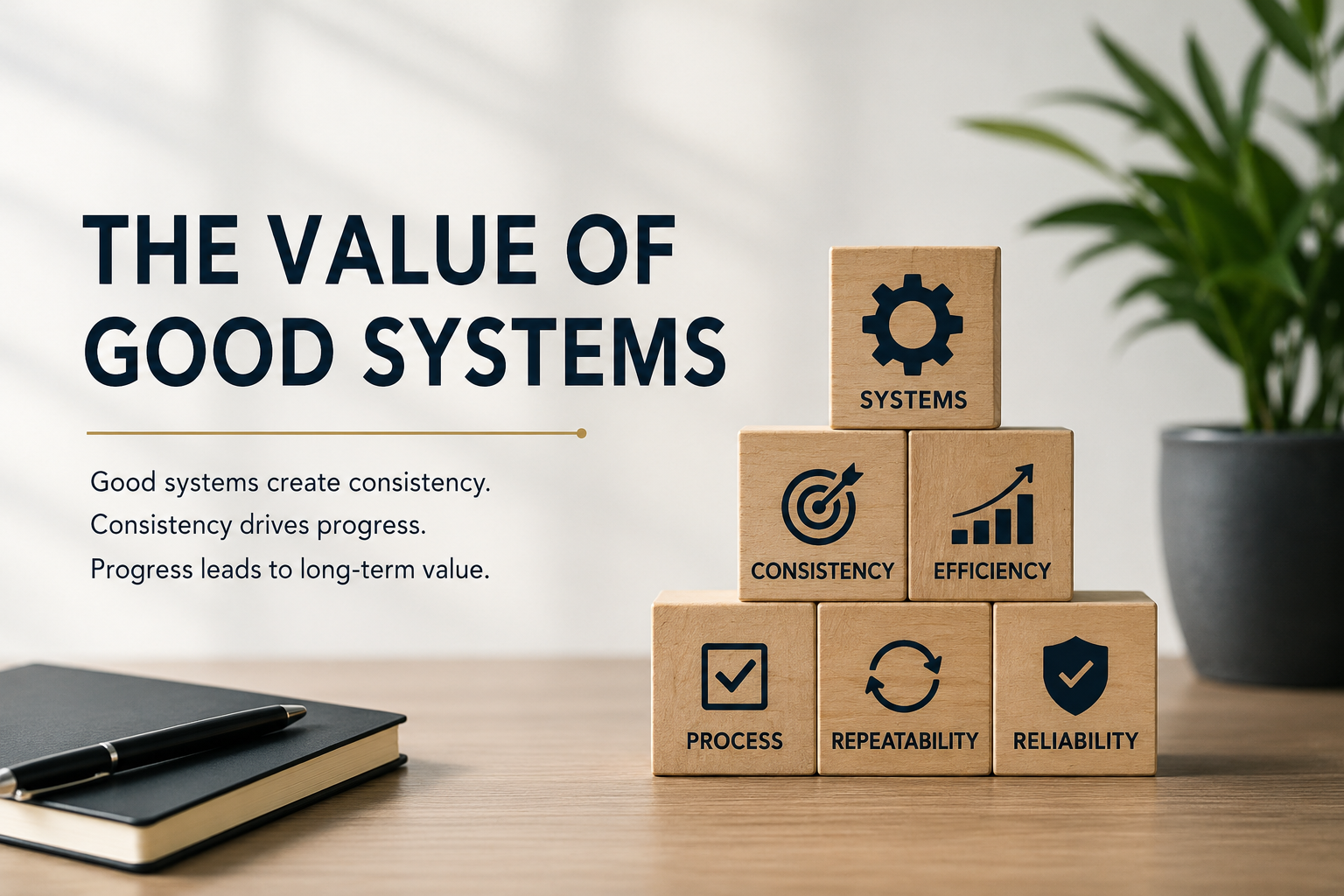
A system is a repeatable process that helps produce a desired outcome. Unlike motivation, systems continue to function even when enthusiasm fades. They reduce the need to constantly make decisions and help turn important activities into habits and routines.
Consider personal finances. A person may feel motivated to save money after reading a book or watching a video about financial success. That motivation may last for a few days or a few weeks. However, a system such as automatic savings contributions can continue producing results long after the initial motivation disappears.
The same principle applies in business.
Organizations that consistently perform well are rarely relying on motivation alone. Instead, they develop processes, procedures, controls, and routines that help produce reliable outcomes. Good systems make success more predictable and less dependent on individual effort or circumstance.
Technology often follows the same pattern. Many organizations invest heavily in new software expecting it to solve existing problems. In reality, technology tends to amplify the systems that already exist. Strong systems often become more efficient with technology, while weak systems frequently become more complicated.
This idea can also be applied to personal productivity. Rather than relying on motivation to complete important tasks, it is often more effective to create routines that make those tasks easier to start and easier to maintain. Small actions repeated consistently usually outperform occasional bursts of intense effort.
Over time, systems create compounding results.
A well-designed system may not produce dramatic outcomes immediately. In fact, the results are often difficult to notice in the beginning. However, as days become weeks, weeks become months, and months become years, the impact becomes increasingly significant.
This is one of the reasons I find systems so interesting. They operate quietly in the background and help create consistency, structure, and repeatable results over time.
Motivation can help us get started.
Systems help us continue.
And in many cases, the ability to continue is what ultimately makes the difference.